
Each year, thousands of Australians hand their phone over to some repair shop and just walk away worse off, like a cracked screen “fixed” with a cheap panel, a battery that swells within weeks, or a bill that ends up being double what they were first quoted. The phone repair scams in Australia seem more frequent than most folks think, and understanding how the whole thing works is honestly the best defence you have.
How Do You Spot a Phone Repair Scam in Australia?
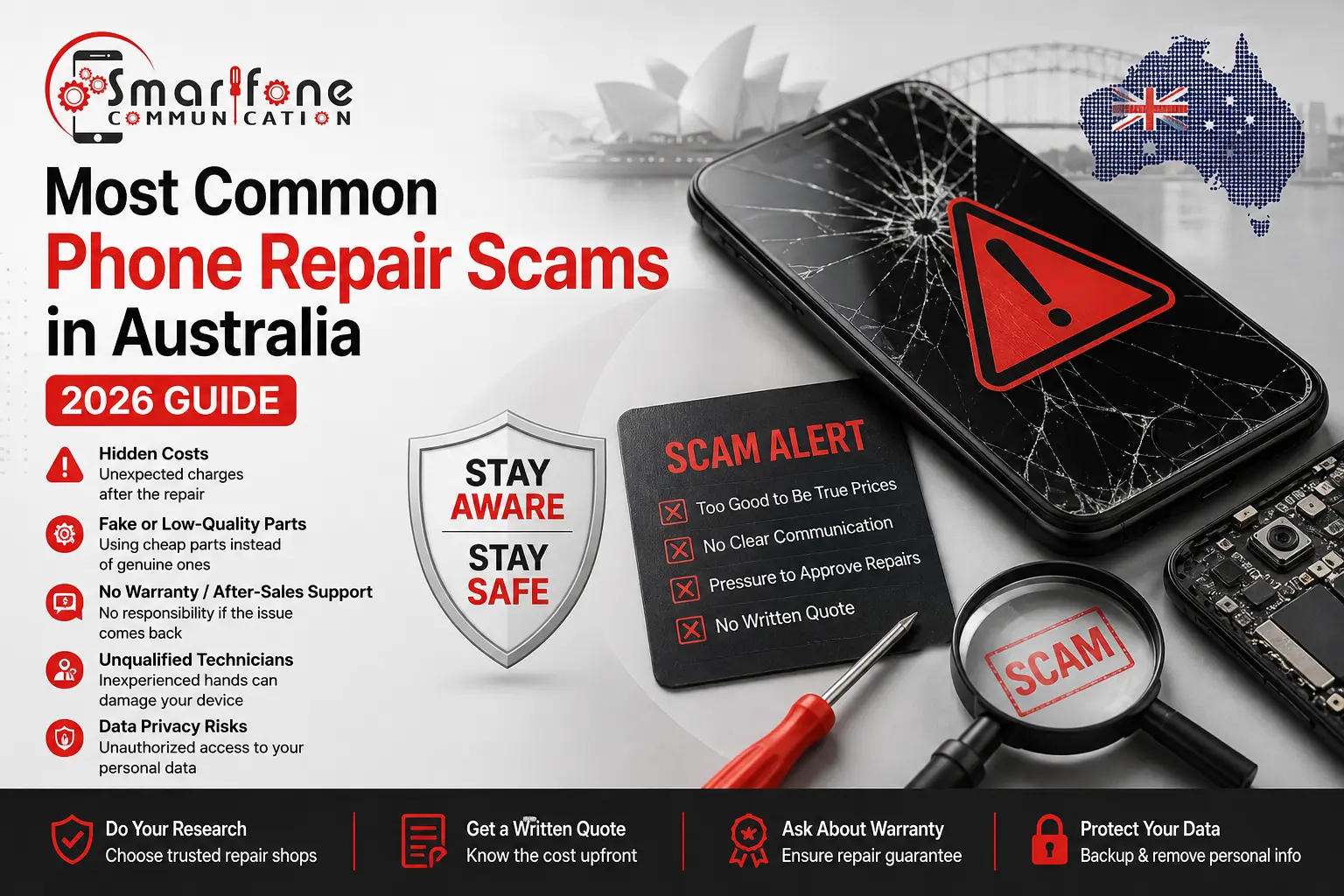
In Australia, the most common phone repair scams usually circle around parts that are counterfeit or refurbished… but they’re sold like they’re “genuine” (OEM). Then there’s that bait-and-switch pricing thing where the initial repair quote looks normal, but the final bill is way higher, like somehow. Some places also add unnecessary “repairs” for issues that don’t really exist, or they’ll go fishing for data, snooping while your phone is sitting in a technician’s hands. And yeah, fake warranty promises pop up- the kind that disappear the second something goes wrong, which is just super convenient for them.
To protect yourself, try to get a written repair estimate before anything starts, ask about technician certification, check Google results and ACCC reviews, and pick a shop that includes a genuine repair warranty in writing.
Why Phone Repair Scams Are Rising in Australia
Reports of phone repair scams in Australia have grown alongside the industry itself.
Smartphone repair has become a fast-growing, kind of largely unregulated business. In Australia, there isn’t really a national licensing scheme set up for mobile phone technicians, so basically almost anyone can pop open a kiosk or a shopfront and call themselves a repair technician.
The Australian Competition and Consumer Commission (ACCC) receives thousands of scam and misleading-conduct reports across retail and repair services each year through Scamwatch, and phone and electronics repair complaints are a recurring category in state-based consumer affairs data. Under Australian Consumer Law, you’re entitled to repairs that are fit for purpose, use parts as described, and come with consumer guarantees regardless of what a shop’s own “policy” says.
Kiosk-style repairers in shopping centres are especially prone to high staff turnover, which makes it harder to hold any one technician accountable if a repair goes wrong. Many operate under a trading name that differs from their registered ABN, which can make it difficult for customers to know exactly who they’re dealing with or who to complain about later.
That legal protection only helps if you can recognise a scam before it costs you. Below are the seven most common tactics used against Australian consumers, plus how to avoid every one of them.
7 Common Phone Repair Scams in Australia to Watch For
1. The Counterfeit Parts Switch
This is the single most reported issue in the mobile repair industry. A shop advertises a screen replacement or battery replacement scam-free service, but quietly fits a cheap, unbranded part instead of an OEM (original equipment manufacturer) component.
How it shows up:
- iPhone example: A customer pays for a “premium” screen replacement, but then the new display has weird touch response, dull colors, or throws a “genuine parts unavailable” warning in iOS.
- Samsung repair example: A replacement battery bleeds power way faster than the original, or the phone starts overheating while charging, within a few weeks after the repair.
Counterfeit parts are cheaper for the shop to source, but they degrade faster, void manufacturer diagnostics, and can pose safety risks, particularly with lithium-ion batteries.
2. The Bait-and-Switch Repair Quote
You’re given a low repair quote over the phone or in-store to win the job, then told after the phone is already disassembled that “additional damage” was found and the price has doubled or tripled.
Red flag phrasing: “We found more damage once we opened it up.” Legitimate technicians diagnose visible and testable issues before quoting, not after your phone is in pieces and you have no leverage to walk away.
3. Unnecessary Repairs and Manufactured Faults
Some shops recommend replacing parts that were never faulty a new charging port when the issue was just a dirty connector, or a new motherboard when a software reset would have solved the problem.
In a small number of documented cases, technicians have been accused of deliberately loosening or damaging a component during “diagnosis,” so they could justify billing for a repair that was not really needed in the first place.
4. Hidden Fees and Add-On Charges
The advertised price seems fairly competitive, yet once the dust settles, the final invoice adds things like “diagnostic fees”, “express service surcharges”, “part sourcing fees”, or “reassembly charges” that, honestly, were not explained upfront.
Under Australian Consumer Law, businesses can’t run misleading or deceptive pricing practices. If those hidden add-ons weren’t plainly disclosed before you okayed the repair, you might have grounds to ask for a refund or lodge a complaint through your state’s consumer affairs office.
5. Data Theft and Privacy Risk
Handing over an unlocked phone gives a dishonest technician access to photos, banking apps, saved passwords, and personal messages, which sounds small, but it’s a real threat. This is a genuine data theft risk, especially at unregulated kiosk-style repairers, where staff turnover is high, and there is no formal privacy policy in place.
To protect yourself, back up your device, sign out of sensitive apps, and ask the shop, straight up, what their data-handling and staff-access policy is, before you hand anything over.
Some repairers ask for your PIN or passcode “to test the screen,” and sure, that’s sometimes genuinely required. But a trustworthy technician should explain exactly why it’s needed, test the phone in front of you when possible, and never ask you to write your PIN down along with your name and phone number on a repair ticket. If a shop insists on taking your phone into a back room while you’re waiting, and there’s no clear reason, then it’s reasonable to ask more questions, or just take your device elsewhere.
6. Fake or Worthless Warranty Claims
A shop says, verbally, it offers a “12-month warranty ”, yet it gives you no paper in hand at all. After the repair goes wrong, they later insist the problem is “ not connected ” to what they did, or they say the business is somehow gone and then it came back again under a different name.
A genuine repair warranty should be written, itemised, and specify exactly what is and isn’t covered, including whether it covers parts, labour, or both.
7. Fake Phone Repair Shops and Pop-Up Scams
Some bogus phone repair places hang around for a few months at a mall kiosk; they take payment for repairs or trade-ins, then just disappear before anything really shows up. Other outfits push these very aggressive discounted mail-in repair offers; they collect the money upfront, and then the device is never seen again, like its vanished.
Warning signs: No fixed business address, no ABN displayed, and payment requests via direct bank transfer or gift cards rather than traceable methods.
Fake phone repair shops are getting more and more active online too, and they advertise those super low-priced screen replacement “deals” kind of loudly on social media ads, or on marketplace listings, as well. People end up posting their phone for “repair”; they pay upfront, and then either the device comes back not fixed, or it’s damaged even more, or it just never shows up. So yeah, make it a rule: before you send your device anywhere, always check that the online repair business has a real, verifiable street address and that their reviews stay consistent across multiple platforms.
Phone Repair Warning Signs: A Quick Checklist
Watch for these phone repair warning signs before you commit to any repair:
- No written repair estimate or quote before work begins
- Reluctance to say whether parts are OEM, genuine, or aftermarket
- No visible ABN, licence, or physical shopfront address
- Pressure to pay in full upfront, especially via untraceable methods
- No warranty offered in writing
- Technician can’t explain their certification or experience
- Reviews mention “final price was higher than quoted”
- Requests your phone’s PIN with no explanation of why it’s needed
Legitimate Repair Shops vs Scam Repair Shops
| Factor | Legitimate Repair Shop | Scam Repair Shop |
| Repair quote | Written, itemised, given before work starts | Verbal only, changes after disassembly |
| Parts used | OEM or clearly disclosed high-quality aftermarket parts | Counterfeit parts passed off as genuine |
| Warranty | Written repair warranty with clear terms | Verbal promise only, or none at all |
| Technician certification | Can show training, experience, or manufacturer accreditation | Vague or evasive about qualifications |
| Pricing | Fixed quote, no surprise fees | Hidden charges added to final bill |
| Data security | Clear privacy policy, backup recommended, staff access controlled | No policy, phone left unattended with staff |
| Business transparency | ABN displayed, fixed address, verifiable reviews | No ABN, pop-up location, inconsistent reviews |
| Turnaround honesty | Realistic timeframes communicated upfront | “Same day” promises that blow out with no explanation |
How to Choose a Trusted Phone Repair Shop
Ask for a written repair estimate first
A trustworthy repair technician will diagnose the fault and give you a written quote before opening the device. If a shop won’t commit to a price in writing, treat that as a warning sign, not a formality.
Confirm the parts are genuine or clearly disclosed
Ask directly: “Is this an OEM part, or an aftermarket equivalent?” A reputable shop will tell you honestly and explain the price difference. This matters most for iPhone repair and Samsung repair jobs, where display quality and battery safety are directly tied to part quality.
Check technician certification and experience
Manufacturer-trained or industry-certified technicians are more likely to follow correct repair procedures, use anti-static equipment, and properly test the device before handover.
Read recent reviews, not just the star rating
Look specifically for mentions of pricing accuracy, part quality, and whether the warranty was honoured, not just overall star ratings, which can be inflated.
Get the warranty in writing
Before you leave the shop, confirm what’s covered, for how long, and what would void it. Take a photo of the receipt and warranty terms.
Back up your data and ask about privacy practices
Before any repair, back up your phone and ask how the shop handles customer data while the device is in their possession.
Verify the business is real
Check for a registered ABN, a fixed address, and consistent trading history. A quick search on Scamwatch or your state consumer affairs register can confirm whether complaints have been lodged against the business.
Frequently Asked Questions
Among phone repair scams in Australia, the most common is fitting counterfeit or low-quality parts while charging the price of genuine OEM components, most frequently seen with screen replacement and battery replacement services.
Check display colour accuracy, touch responsiveness, and battery health readings after the repair. On iPhone, a genuine-parts warning may appear in Settings if a non-OEM screen or battery was fitted. Ask the shop for documentation showing the part source before the repair.
It can be, provided the business is verifiable, has a written data-handling policy, and you’ve backed up and logged out of sensitive apps beforehand. Avoid shops that ask for your PIN without a clear, specific reason.
A fair repair estimate should be written, itemise parts and labour separately, disclose whether parts are OEM or aftermarket, and state the total price before any work begins.
Under Australian Consumer Law, you may be entitled to a refund or price adjustment if charges were not clearly disclosed upfront or the repair wasn’t fit for purpose. You can lodge a complaint with your state consumer affairs office or the ACCC’s Scamwatch.
Most reputable Australian repair shops offer a minimum 3 to 12 month warranty on parts and labour. Anything less, or a warranty that’s only verbal, is a red flag.
Are mail-in phone repair services safe? Some are legitimate, but mail-in services carry higher data theft risk and less accountability if something goes wrong. Only use mail-in repairers with verifiable business details, tracked shipping, and a written warranty policy.
Get Your Phone Repaired the Right Way — With Smartfone
You shouldn’t have to gamble on whether your repair technician is honest. Smartfone provides transparent, written repair estimates, genuine OEM parts wherever possible, certified technicians, and a written repair warranty on every job so you know exactly what you’re paying for and what’s covered if anything goes wrong.
Book a free, no-obligation repair quote with Smartfone today and get your iPhone or Samsung device fixed by technicians who tell you the truth about parts, pricing, and timeframes before you commit to anything.
Key Takeaways
- Phone repair scams in Australia most often involve counterfeit parts, hidden fees, and bait-and-switch pricing.
- Always get a written repair estimate before any work begins.
- Ask directly whether OEM or aftermarket parts will be used, especially for iPhone and Samsung repairs.
- A genuine repair warranty is written, itemised, and time-bound — verbal promises aren’t enough.
- Protect your data by backing up your phone and asking about staff access policies before handover.
- Verify the business has a real ABN, fixed address, and clean complaint history before trusting them with your device.
- Australian Consumer Law protects you against misleading pricing and unfit repairs — use it if something goes wrong.
This guide is general information, not legal advice. For specific consumer rights concerns, contact the ACCC via Scamwatch or your state consumer affairs office.